

Late-ripening peaches bring prosperity to Quanli township
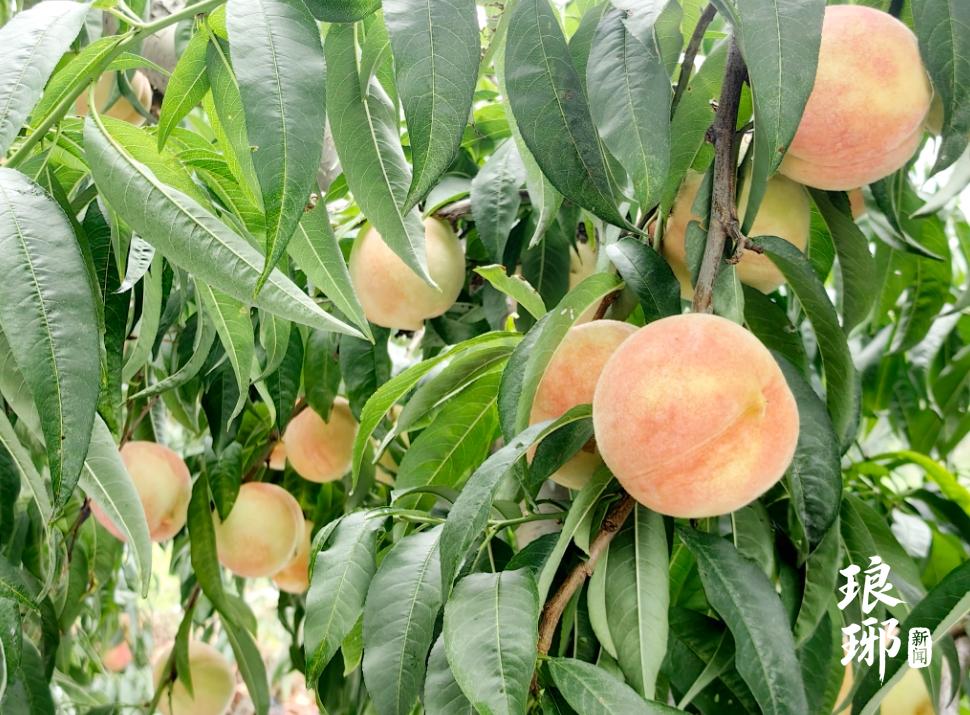
In late autumn, peach trees laden with red fruit bend over the branches on the southern slopes of Tangwang Mountain in Yishui county, Linyi, East China's Shandong province, filling the air with fragrance. This is the busiest season in Quanli township — and the most relaxed.
Months ago, when peach growers elsewhere were rushing fruit to market in the summer heat and undercutting one another, the trees in Quanli township "chose to be late," skipping the early-season rush and the peak-season noise to appear only around the Mid-Autumn Festival and National Day holidays, when peaches from most production areas nationwide had already left the market.
In the orchard in Qijian village, grower Wang Zhencai bends over to pick fruit, sweat running down his weathered face but a smile in his eyes. "Try it — big, crisp and sweet, with a sugar content of 14 or 15 percent," he said, handing over a large peach. His peaches sold for more than 4 yuan (about 56 cents) per jin this year, and the entire output from his 3 mu (0.2 hectares) was snapped up by buyers at the field. Since the village developed the peach industry, residents' per capita income has risen by 5,000 yuan.
The decision dates back to 2012, when Quanli township was still a mountainous area dominated by traditional grain crops, with little arable land, thin soil and scarce water. After extensive research, the township made what then seemed a counterintuitive choice: to grow peaches — late-ripening ones.
The answer lay in a gap in the market. Early and mid-season varieties crowd the market nationwide, while late-ripening varieties are in short supply, and mid-to-low-end products flood the market while premium fruit is hard to find. Early peaches appear from May to June and late peaches from July to September, leaving a coveted window after late September.
The township selected the "Jinqiu Hongmi" variety as its leading cultivar. Its fruit development period lasts up to 175 days, nearly twice that of ordinary peaches, allowing sugar to accumulate slowly over a long growing cycle, with sugar content generally reaching about 18 percent. Its market window falls precisely from mid-to-late September to October, in time for the Mid-Autumn and National Day holidays, while the Yingshuanghong variety extends sales to mid-to-late November.
The "time difference" has become the township's core competitive strategy. When peaches from other areas have left the market, Quanli's are just ripening. This advantage has made the peaches not only easy to sell but highly profitable: well-managed orchards at peak production can earn 10,000 yuan per mu, far more than traditional grain crops.
Quality remains the foundation. Located in the heart of the Yimeng mountains, Quanli township is mostly hilly terrain with deep soil and abundant sunshine, forming its own watershed system with a distinct microclimate. Large temperature differences between day and night allow sugar to accumulate efficiently.
In 2013, Party members in Qijian village took the lead in trial planting, and the township Party committee coordinated 460,000 yuan in subsidies for peach seedlings. Villagers followed suit, and the village's peach planting area reached more than 1,200 mu within two years. When the first trees came into production in 2017, buyers from Sichuan and Guangdong arrived, with prices reaching up to 4 or 5 yuan per jin.
A "cooperative plus base plus farmers" model has been key. Cooperatives including the Qijian Peach Cooperative, the Tangwangshan Xinlong Fruit Cooperative and the Laopo village Peach Cooperative apply unified technical standards, sorting and buyer contacts, with members covering ordinary and formerly impoverished households, and village collectives sharing in profits. The model addresses the difficulties of farmers working alone: technical guidance, quality standards and sales channels.
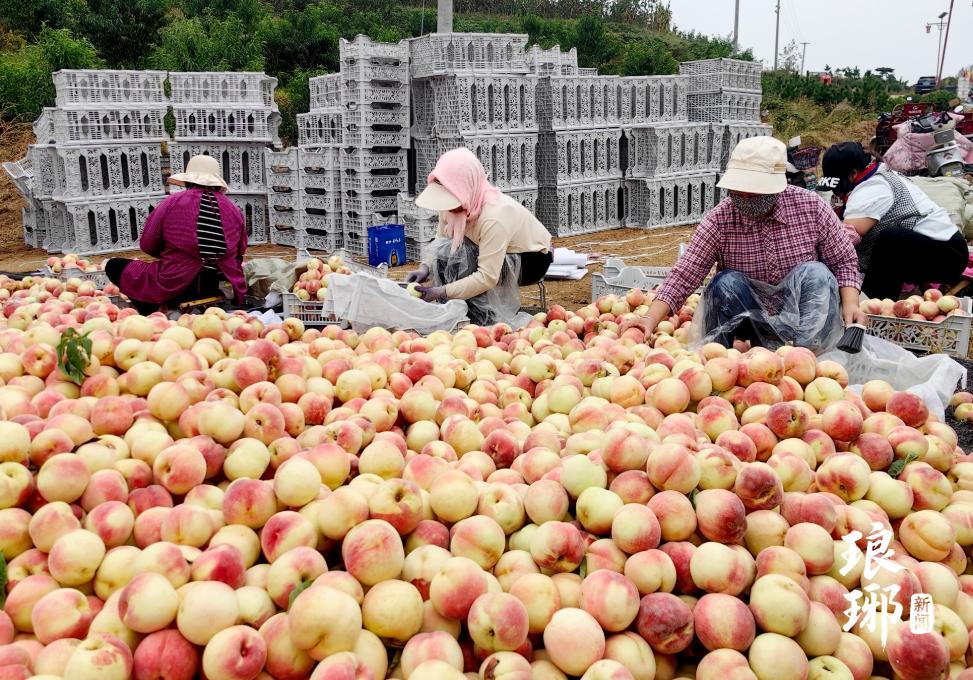
During harvest season in Qijian village, several dozen women brush, sort and box peaches at roadside trading markets, where more than 10 trucks can be loaded in a day for shipment to Beijing, Shanghai and Guangzhou. There are more than 10 such markets in the village, greatly lowering the barrier to selling. A 2,000-square-meter plaza combines trading, sorting and loading with an e-commerce center, and cooperatives provide grading, packaging and logistics services. Buyers at production sites remain the main channel, paying 3.5 to 4 yuan per jin for premium fruit, while online channels including B2B platforms and short-video livestreaming are also expanding, supporting direct shipment from production areas.
Quanli township now has more than 20,000 mu of orchards, including over 10,000 mu of late-ripening peaches, with seven large-scale peach parks. Qijian village has 1,206 mu of peaches, has registered the "Tangwangshan" fruit trademark and obtained green and pollution-free certification.
The township's story reflects a deeper industrial proposition: rather than fighting for a share of the existing market, it created new supply in a market gap.
Editor:韩蒙蒙