

Smart platform manages 1,400 driverless vehicles in Linyi
A large smart supervision screen in a display hall on Yihe Road in Luozhuang district, Linyi in East China's Shandong province, refreshes real-time data on driverless vehicle operations across the city. Dense light points on the screen correspond to each delivery vehicle in service, and a tap on the screen shows a vehicle's location, speed, remaining battery and cargo. Using smart electronic fencing, the system can issue warnings within milliseconds for boundary violations or offline faults.
The system is the Linyi intelligent connected driverless vehicle supervision platform, developed by Linyi University and operated by the Linyi commerce and logistics technology research institute. It has connected more than 1,400 low-speed driverless vehicles across the city, covering over 90 percent of the city's delivery, factory transfer and urban inspection vehicles.
The Linyi intelligent connected driverless vehicle operation center, jointly built by Linyi University and Guangde Group, was unveiled the same day, marking a shift in the city's driverless vehicle industry from scattered supervision and extensive operation to standardized management, large-scale application and low-cost deployment.
Development of the industry relies on cooperation among industry, academia and research. Linyi University has worked in intelligent connected driverless driving for years, with a research team of more than 40 people working on obstacle avoidance, path planning and coordinated operation. The research institute handles day-to-day platform operation, data coordination, system maintenance and feature upgrades, while Guangde Group brings market operations experience, a service team and customer resources.
The platform also addresses long-standing problems in the sector: opaque vehicle trajectories, hard-to-detect violations, difficulty identifying safety hazards and a lack of accountability. It uses color-coded management, distinguishing normal operation, self-maintenance, offline standby and fault shutdown by green, blue, gray and red, making vehicle status clear and abnormalities easy to identify. Electronic fencing covering the whole city sets precise operating boundaries, with the system automatically issuing warnings and recording violations. The platform now provides digital management across application, approval, operation, warning and traceability, with all vehicle data, violation records and maintenance information retrievable and traceable.
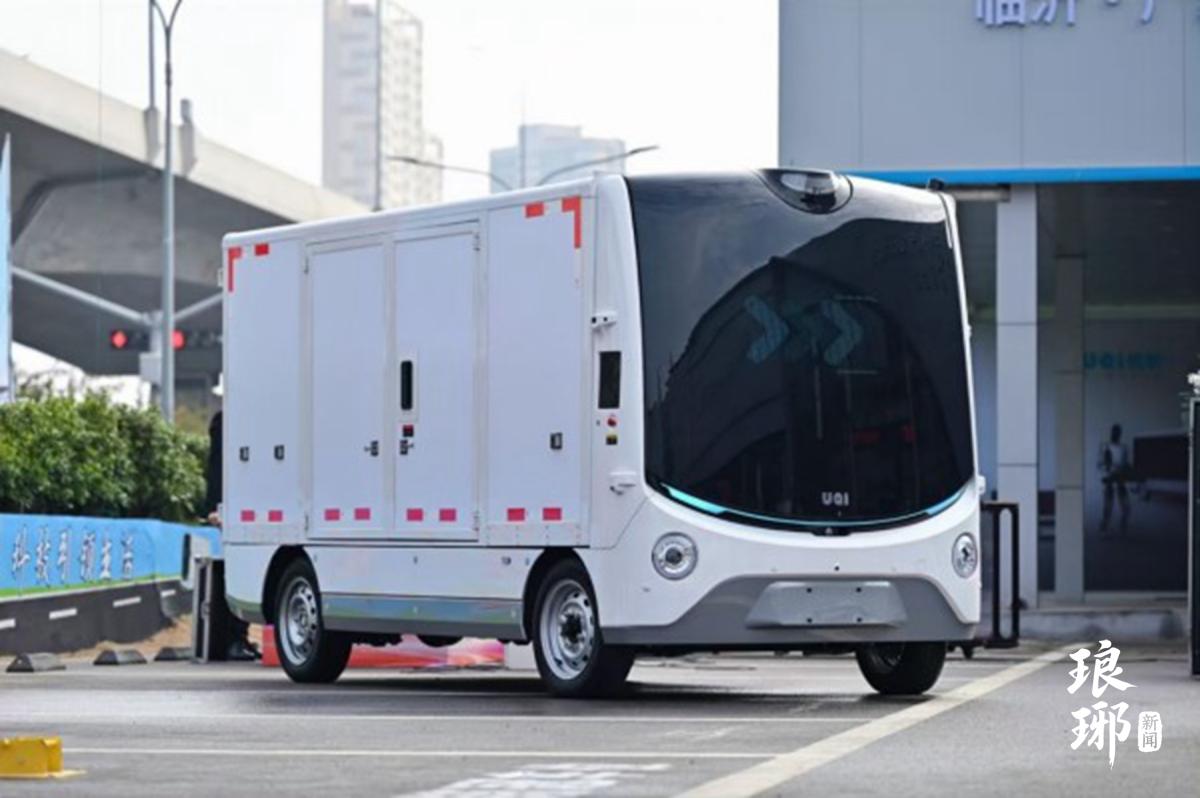
The platform integrates vehicle, order and payment data, intelligently matching orders and automatically planning optimal routes, with online confirmation of loading and unloading and automatic calculation of freight charges, reducing labor costs and communication problems. Driverless vehicles are now used in a range of settings: logistics shuttles connecting goods at freight rates as low as one yuan; temperature-controlled scheduled deliveries for supermarkets and pharmacies with full traceability; campus parcel delivery at universities; and transfers in high-temperature environments at ceramics and aluminum industrial parks in Luozhuang.
Together with a newly opened industrial robot service center — the first of its kind in Shandong — Linyi has built a system covering in-plant robot operations, out-of-plant driverless delivery and big data platform dispatch. Humanoid robots, smart forklifts and towing robots handle in-plant loading and short-distance transport, while high-capacity, long-range driverless trucks take on inter-plant transport, integrating hardware and software across the production and transport process.
Editor:韩蒙蒙