

Linyi's wood industry rebuilds its growth model
What can a single log become in Linyi, a city known as China's capital of wood-based panels? The answer long ago stopped being "one sheet of board". It now spans an entire chain running from raw timber, man-made panels, impregnated paper, adhesives and woodworking machinery to hardware fittings, custom home furnishings and supporting services. That chain is now going through a new round of change.
Behind the shift is a market shakeout. Since last year the national wood panel market has gone through a deep correction and competition has sharpened. "The defining quality of Linyi's wood industry is its resilience," said Guo Yongsheng, chairman of Shandong Qiansen Wood Industry Group. Guo started out at the end of the 1990s making adhesives for panels, moved into panel production in 2014 when he founded Qiansen, and now runs two production bases nationwide with annual output of 600,000 cubic meters of eco-friendly furniture board. In his view, because the chain covers panels, rotary-cut veneer, adhesives, machinery and auxiliary materials, and because it leans on Linyi's logistics base, "price swings cannot knock the industry down — they tend to bring out more vitality".
The trajectory is long. Linyi's first fiberboard plant opened in 1976, the Linyi Decorative Wood Products Market was completed in 1999, and by 2010 the city's panel capacity ranked first in the country. It is now the country's largest base for producing, exporting and trading man-made panels, its largest decorative paper base and its largest woodworking machinery base. The city has more than 13,000 wood and supporting enterprises, whose combined output value as enterprises above designated size reaches 143.85 billion yuan, employing 600,000 people. Full-chain output value exceeds 300 billion yuan.
The problem is not capacity but differentiation. "Full-chain self-sufficiency is Linyi's biggest advantage, but homogenization is serious and companies are not innovative enough," said Sun Fengwen, a professor and doctoral supervisor at the College of Materials Science and Engineering of Nanjing Forestry University. Sun Yunqiang, executive dean of the Linyi Municipal Research Institute of High-end Panel and Green Smart Home Technology, put it in commercial terms: local firms remain too accustomed to "selling boards" and lack the capacity to build high-end brands and design products.
The city government has responded by designating high-end panels and green smart home furnishings as a signature industry chain, to be built through four paths — from low-end to high-end, from coarse to fine, from panel to home furnishing, and from domestic to overseas sales — with the aim of creating a "double 100-billion-yuan" cluster. "Moving from low-grade, extensive production to high-end, refined production is an inevitable choice," said Li Xiu, deputy director of the municipal forestry bureau. Three benchmarks were set: panels against Huzhou, home furnishings against Guangzhou, and support policies against Guigang.
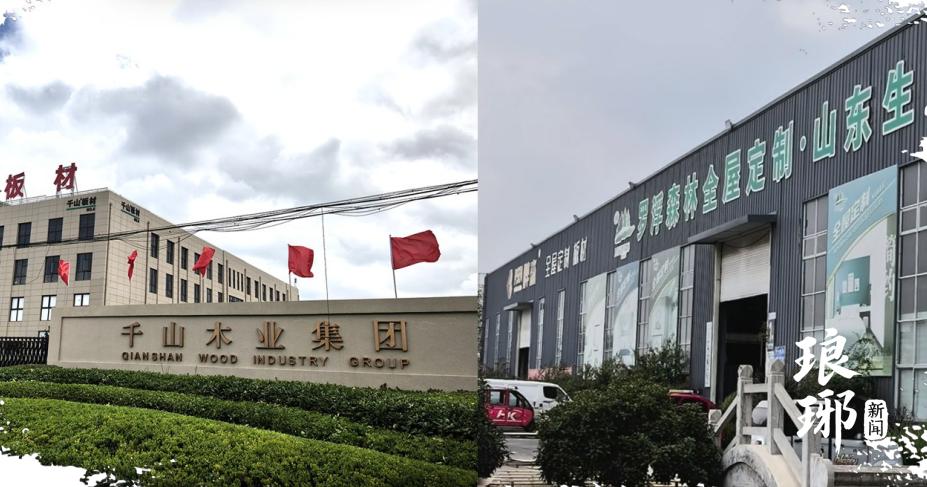
Leading firms are already moving. Qianshan Wood Industry, a chain leader in the cluster, has built self-sufficiency across eco-friendly adhesives, printing paper, impregnated paper, panel production and custom furnishings, and is pushing into high-end panels and custom home furnishing. Its 1.2-million-square-meter whole-house custom project with Shandong Tubaoabo Smart Home has been ramping up production since it opened in May. "We have to improve our own capabilities and also bring the small and medium supporting firms in the cluster up with us, so the whole industry moves off low-end price competition," said Liu Yulian, vice chairwoman of Shandong Qianshan Wood Industry Group.
New players are entering on new tracks. "Linyi is an important stop for us as we move out of Zhejiang and across the country, and the most committed one," said Zhao Jianzhong, vice chairman of Zhejiang Shenghua Yunfeng New Materials, speaking at a Sept 20 meeting on key projects in the chain. Over 28 years the company's Yunfeng Moganshan unit has set up three subsidiaries in Linyi and built long-term production ties with more than 30 local wood firms; its third major project in Linyi, a whole-chain smart home base in Fei county, is under construction. Fujian-based Heqichang, the world's largest single-site maker of bamboo-wood composite container flooring, has located a 200,000-cubic-meter plant in the Bianqiao high-end wood and home furnishing industrial park in Pingyi county. "We use fast-growing bamboo instead of conventional timber, green and low-carbon processes instead of high energy consumption, and a niche track instead of low-end homogenized competition," said Luo Zhifu, deputy general manager of Fujian Heqichang Bamboo Industry.
Others are filling out the map: Kronospan, a European panel brand with a century of history, has landed in Lanshan district to focus on high-end imported panels for custom furnishing factories, premium stores and leading home improvement firms; Treezo Group has invested in whole-house custom furnishing, high-end furniture board and smart home manufacturing in Fei and Tancheng counties; and Shandong Yimu Decorative Materials has built its "Yimu Liangpin" custom furnishing brand around five direct warehouses and 58 strategic regional warehouses serving more than 2,000 customers.
Technology is the other front. Shandong Xingang Enterprise Group, working with the team of academician Li Jian of Northeast Forestry University, has cracked key technologies for biomimetic wood composites and won a first prize in the Shandong Provincial Science and Technology Progress Awards; Qiansen's formaldehyde-free plant-protein adhesive took a gold medal at the Geneva International Exhibition of Inventions. This year the city's wood sector has linked more than 20 universities and research institutes, laid out 55 ongoing research projects and started 16 projects in artificial intelligence, covering surface defect detection, AI corpora and smart production lines.
Exports are following. Mingtuo Group, one of Linyi's earliest panel exporters, chose in 2010 to build its own CONSMOS brand rather than take the subcontracting route. "We want the world to fall in love with building materials made in China," said chairman Zhang Shaolong. Its construction formwork, oriented strand board and all-birch panels now rank among the country's largest export lines, reaching 180 countries and regions. In the first eight months of this year, Linyi's imports and exports of wood and wood products totaled 7.63 billion yuan, up 23.5 percent year on year.
Sun Yunqiang of the research institute argued that the ideal relationship within the chain is not "big fish eating small fish" but "big fish leading small fish": top firms build brands and channels, mid-tier firms deepen niche segments, and smaller firms handle basic processing and supporting services. He also urged the city to invest in waste wood recycling and technology to modify fast-growing timber, so that the industry holds the initiative on costs.
Editor:韩蒙蒙