

Wushu event fosters international fellowship
Personal growth supersedes aspects of competition
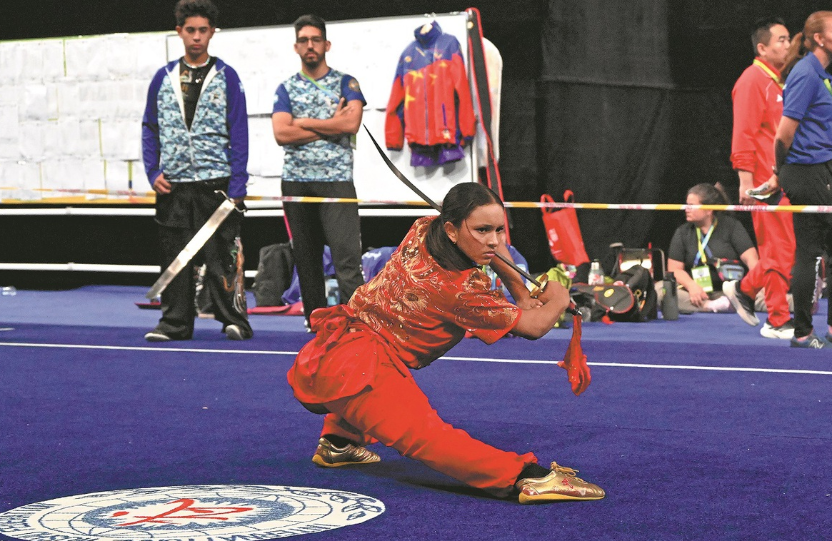
A foreign participant performs daoshu (saber play) during the 10th World Youth Wushu Championships held last month in Tianjin. YAN DONGJIE/CHINA DAILY
The 10th World Youth Wushu Championships had barely concluded in Tianjin recently when a makeshift game broke out on an outdoor basketball court. There was no ball, so a group of teenagers from four different continents chased an empty plastic water bottle instead.
Hours earlier, these same athletes were locked in fierce combat.
Now, the rivalry had vanished. In its place was a scene that captured the fundamental paradox of wushu: a sport that teaches you how to strike, primarily so you have the discipline not to.
For Swiss athlete Leandro Gia-Hy Luong, the most enduring lesson of his career so far isn't a high kick or a lightning-fast palm strike. It is a two-word command from his coach:"Don't fight."
For Luong, who inherited the sport from his father, wushu is an exercise in self-restraint. It is the art of "stopping conflict", a philosophy reflected in the very etymology of the Chinese character for martial "wu", which is composed of the radicals for "stop" and "spear".
Referee Anthony Sims from the United States shared a similar observation. "In almost every sanda match I officiate, I see the same scene," he said. "After an intense bout on the platform, the athletes often walk off and embrace each other or exchange shoulder pats in encouragement."
That is why, when asked to describe wushu in three words, Sims did not choose "strength" or "speed" or "cunning", but "perseverance", "humility" and "growth".
"I have been officiating for more than 20 years," Sims said. "I believe wushu makes people physically stronger and shapes values such as restraint, reflection and continuous growth. Mental strength is the most important."
Editor:韩蒙蒙