

Linyi Daily runs eight-page special on city's industrial rise
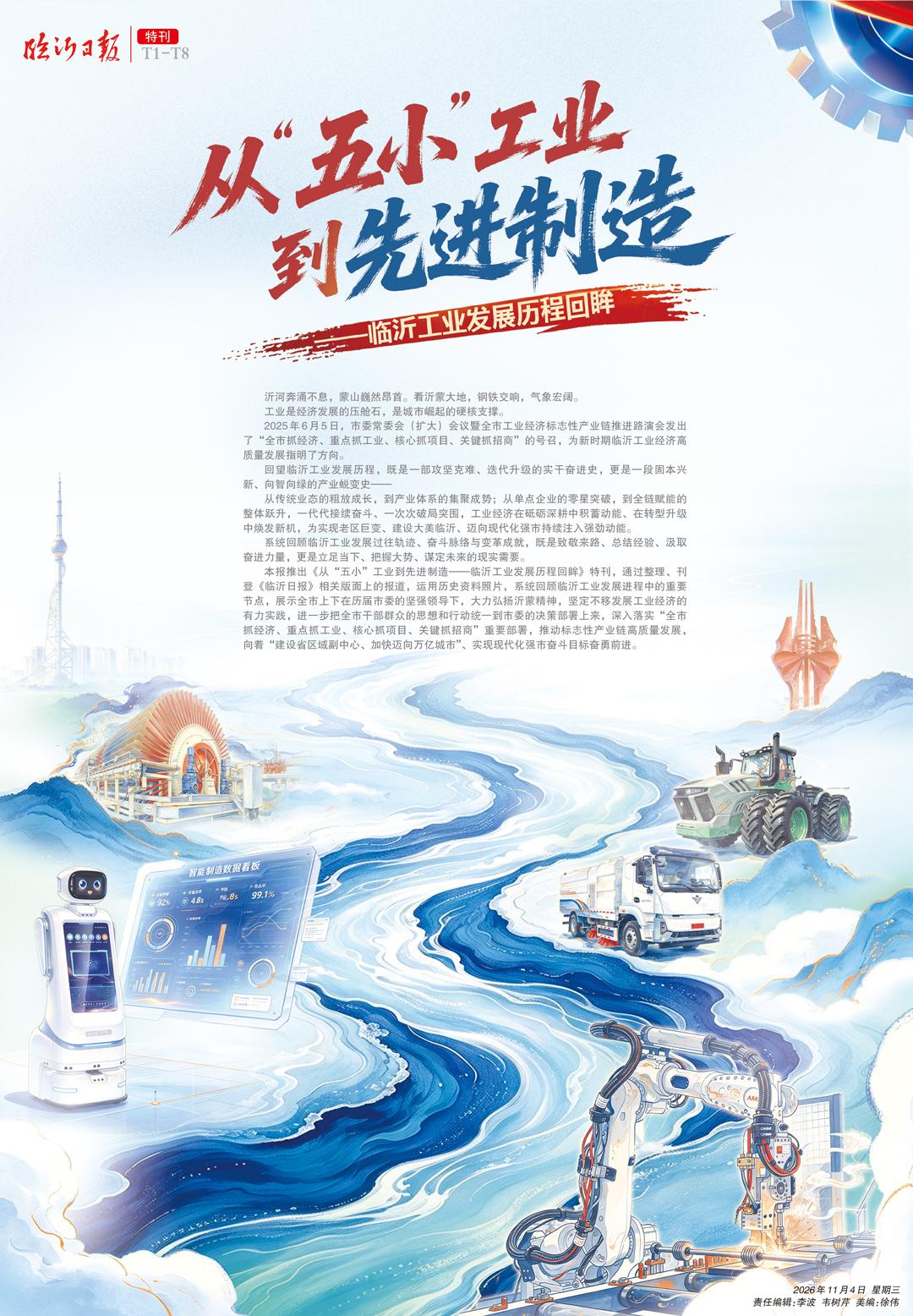
Linyi Daily published an eight-page special supplement on Nov 4 titled From "Five Small" Industries to Advanced Manufacturing: A Retrospective of Linyi's Industrial Development, reviewing key milestones in the city's industrial history.
In the early years of the People's Republic of China, industry in the Yimeng mountain area was extremely weak, dominated by agriculture and limited to "five small" industries — small coal mines, chemical fertilizer plants, cement plants, farm machinery works and textile mills.
From 1978 to 1991, riding the wave of reform and opening-up, Luozhuang district took the lead in developing township industries, with ceramics, textiles and building materials flourishing to form a nationally known model. By 1991, the total output value of township enterprises in Linyi exceeded 10 billion yuan, accounting for half of the region's industrial output.
From 1992 to 2002, the rapid formation of Linyi Trade City pushed local manufacturing to expand under a "orders from the market, processing at home" model. State-owned enterprise reform and a relaxed environment for the private sector nurtured local leaders such as Jinluo, Huasheng Jiangquan and Shandong Lingong. In 1993, the city's secondary industry value added surpassed the primary sector for the first time, and by 2002 the private sector accounted for more than 52 percent of GDP.
From 2003 to 2011, industrial parks including the Linyi Economic and Technological Development Area, the Linyi High-tech Industrial Development Zone and the Linyi Lingang Economic Development Zone were established, moving industry from scattered rural layouts to clustered parks. Five 100-billion-yuan industry clusters took shape in wood panels, hardware, food, construction machinery and compound fertilizer.
From 2012 to 2021, Linyi aligned with the province's pilot for replacing old growth drivers with new ones, phasing out outdated ceramics, low-end panels and small chemical plants while upgrading equipment and processes and laying out new energy, new materials and next-generation information technology.
From 2022 to 2024, the city set "rising in both quantity and quality, reaching one trillion yuan in two years" as a central task for high-quality development. On June 5, 2025, a municipal meeting on signature industrial chains made industry the city's "number one project", establishing a chain-chief system and an industrial operations command center, and rolling out a series of actions on chain integration, digital transformation, technological upgrading and tiered cultivation of quality enterprises.
On Dec 29, 2025, the city's economic work conference set the goal of "building a provincial sub-center and accelerating toward a trillion-yuan city", and work began on benchmarking, AI Plus, Trade City going global, a new leap in the private economy and regional cooperation.
Editor:韩蒙蒙