Linyi shifts grain drying from sun-drying to mechanical systems
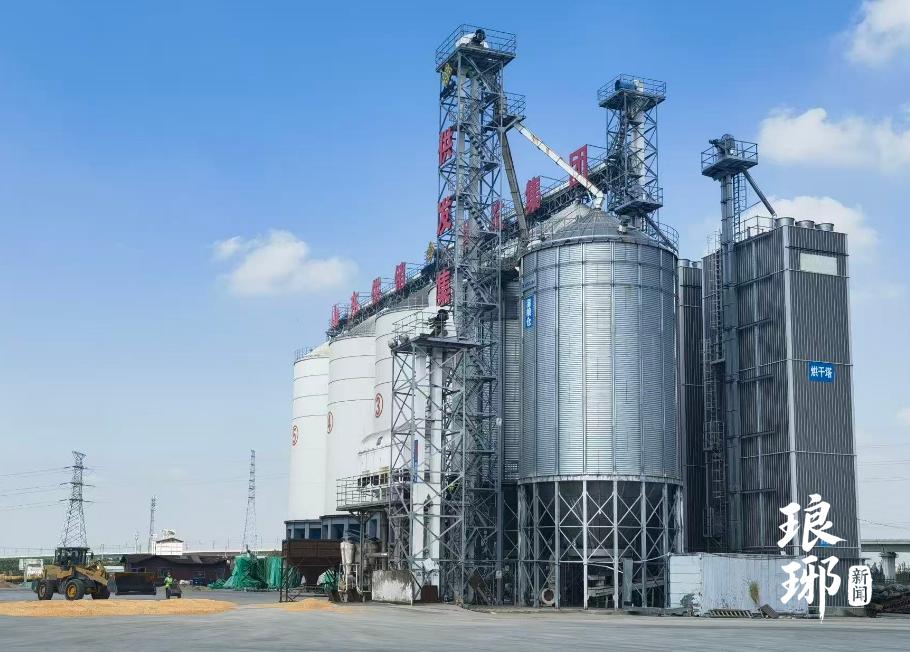
Grain drying in Linyi, East China's Shandong province, is shifting from traditional sun-drying toward mechanical systems, as the city's autumn harvest approaches its end.
"Moisture content 13 percent — just right." As a drying tower started up for the first time, the first batch of corn came out, and Pang Xuecai picked up a handful to smell it before inserting a moisture meter, which showed a figure matching the preset level exactly. On Oct 8, the large-scale grain grower made the leap from sun-drying to mechanical drying.
Pang, a farmer in Qingyun town, Linshu county, has expanded from 36 mu to more than 4,000 mu. Land has been her career and lifeline at 63, with more than 3.6 million yuan invested in storage construction alone. Last autumn's heavy rains — the worst in more than 60 years, with rainfall in some parts of Linyi nearly five times the level of the previous year — left part of her corn rotting in the fields and the harvested crop unsellable at sun-drying prices, costing more than 600,000 yuan.
Pang and her son Xie Junyong decided that for large-scale farming, the chain of cultivating, planting, managing, harvesting, drying and storing would collapse without the drying link. They decided to install a drying tower.
Meanwhile, the city's agriculture authorities were assessing the impact of abnormal weather on grain harvesting. After surveying drying systems across counties and districts, they identified shortcomings and drew up a three-year plan to improve the city's grain drying capacity, promoting drying facilities of different scales and types suited to local conditions.
The city's agricultural machinery center published a map of drying facilities, marking a flame symbol for each new drying point. In just one year, the number of flames rose from 89 to 131, and drying equipment increased from 225 to 297 units, a rise of 32 percent.
Coordinating land use, handling approvals and providing subsidies were the three measures the city's agriculture authorities adopted. Policy soon reached Pang's fields, and her first drying tower went into operation this corn harvest season. Equipment is made by local companies in Linshu. One tower dries corn from her own 1,500 mu; another is being tested to serve nearby cooperatives and large growers; a peanut dryer is also being installed. The government approved facility land for three drying units and provided 174,000 yuan in subsidies on nearly 1 million yuan of equipment investment.
Across Linshu county, building 20 new drying points was a key livelihood project this year. The county opened green channels for land applications and project filings and provided one-on-one tracking services, adding 1,800 tons of daily drying capacity within the year, up 150 percent from last year.
Citywide, large growers, family farms, planting cooperatives, agricultural machinery cooperatives and grain storage enterprises are building drying facilities — large and medium-sized, fixed and mobile, powered by gas, fuel or biomass pellets.
At the Yikangyuan planting cooperative in Huyang town, Fei county, vehicles deliver corn from fields to a drying tower powered by biofuel, which delivers hot air into the drying chamber for slow dehydration over more than 20 hours, handling 100 tons a day with most capacity serving surrounding villages. In Taiping subdistrict, Hedong district, two imported drying towers at the Lugong farm run on natural gas and dry 500 tons of corn daily, serving more than 30,000 mu under the farm's management, with dried grain moved into large silos.
After a year of effort, the city's daily grain drying capacity has reached 34,000 tons, covering about 35 percent of total corn and rice output. Cao Shijie, director of the city's agricultural machinery center, said that in plain-dominant counties and districts such as Hedong, Linshu and Tancheng, summer and autumn grain can be dried on request — as long as farmers want drying services, they can readily find facilities.
Pang said one set of equipment dries 60 tons of corn a day, while sun-drying the same amount would require more than a football field. Before drying facilities became widespread, vacant land, roads, rooftops and even institutional courtyards were used for drying grain, encroaching on public space and creating traffic hazards.
Mechanically dried grain also has precisely controllable moisture content — 13 percent for corn and 12.5 percent for wheat — meeting the needs of long-term storage or flour processing, whereas sun-drying risks losses if too dry and mold if too wet, and sun-dried grain contains impurities with higher breakage rates.
On costs, Pang said natural gas adds about 2 fen per jin and biomass pellets about 3 fen, but natural drying requires two or three rounds, and transport and turning costs more in labor than mechanical drying. "This year's corn has been fully harvested and all mechanically dried. The 1,500 mu should bring in 1.5 million yuan in gross income."
"Moving from natural drying to mechanical drying is not only a technological advance but also a shift in agricultural production methods that promotes specialization and intensification," said Zhang Dongsheng, director of the city's agriculture and rural affairs bureau.
Editor:韩蒙蒙
LATEST
- Mengyin county embeds legal review in industry chain development
- Linyi's immersive tourism shines during National Day holiday
- Linyi airport handles 54,000 passenger trips during National Day holiday